
BMW N20 timing chain failure is a known concern in certain early engines, but a production date or noise alone cannot confirm it. If you own or are considering an N20-powered BMW, check both the timing chain and the oil-pump drive chain. BMW service information identifies a lower-engine whine that rises with engine speed as one reason to test the chain system. It does not treat noise alone as proof of failure. A quiet start is not proof of a healthy chain either, especially when the car has no service history.
The sensible approach is to confirm the engine by VIN, review its maintenance and repair records, listen from a true cold start, scan the engine control module and inspect the chain system before deciding whether parts are needed. The same inspection should also cover the N20’s oil leaks, cooling system, boost control and drivability.
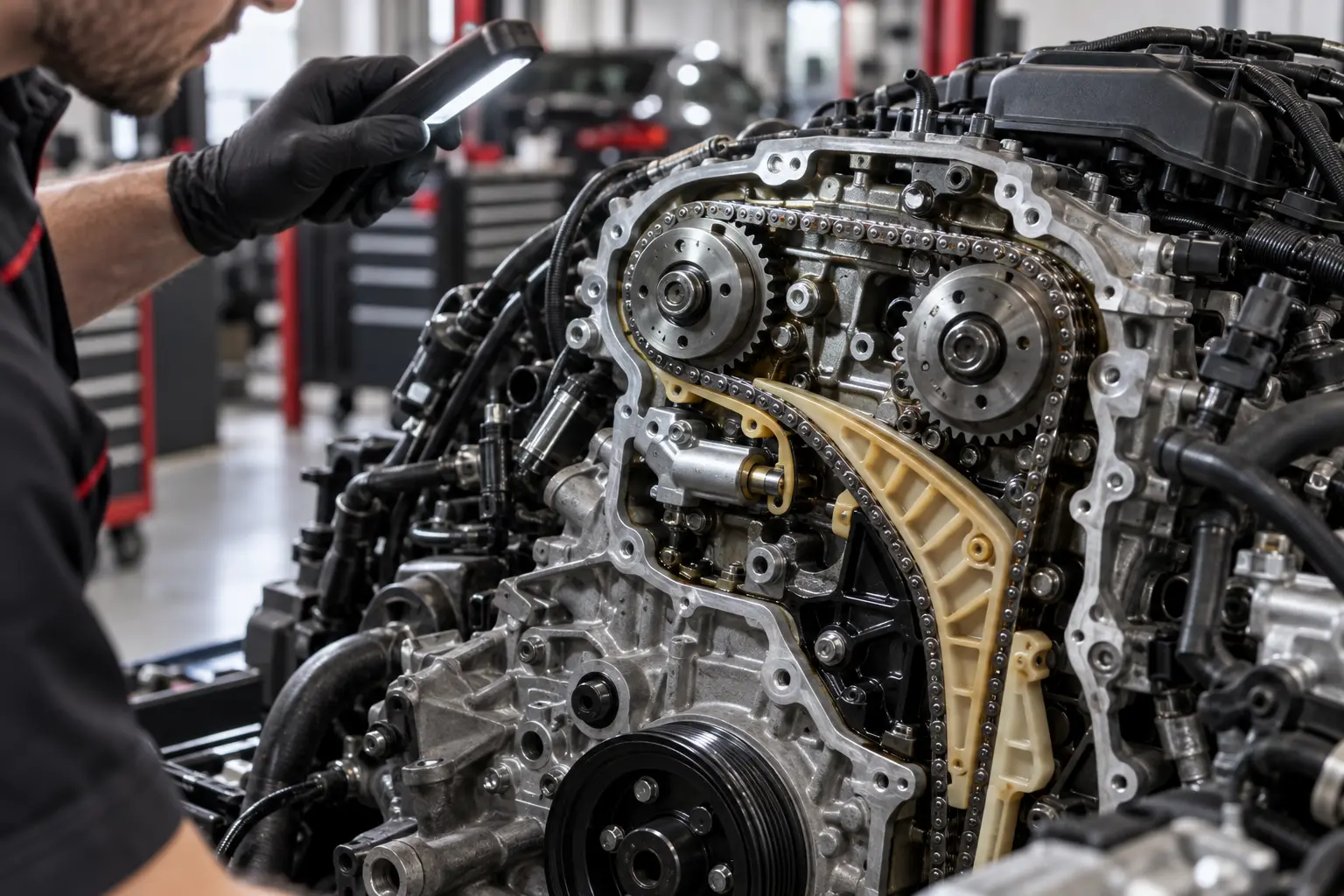
Know which engine you have
The N20 is BMW’s turbocharged four-cylinder petrol engine introduced in the early 2010s. BMW describes its core technology as a 1,997 cc engine with a twin-scroll turbocharger, High Precision Direct Injection, Double-VANOS camshaft timing and VALVETRONIC variable valve lift. Those systems explain why an N20 can feel strong at low engine speeds, but they also mean that rough running or hesitation can have several possible causes.
Badges are not enough to identify the engine. Model year, production date, destination market and previous engine replacement can change what is fitted. A 320i, 328i, 520i, 528i, X1, X3, X4 or Z4 from the relevant period may use an N20, but the VIN and engine designation should settle the question before any N20-specific advice is applied.
| Where the N20 appears | Examples worth checking | What to verify |
|---|---|---|
| 2, 3 and 4 Series | 228i, 320i, 328i and 428i | VIN, production date and actual engine code |
| 5 Series | 520i and 528i in relevant markets | Market specification and any engine replacement history |
| BMW X models | X1 28i, X3 28i and X4 28i | Rear-wheel drive or xDrive does not confirm the engine |
| Roadster | Z4 sDrive20i or sDrive28i in relevant markets | VIN and engine label rather than badge alone |
North American cars may have the related N26 SULEV engine. BMW’s US timing-chain bulletin covers both N20 and N26 applications, but its warranty terms apply only to eligible US-specification vehicles operated and repaired in the United States or Puerto Rico. A UAE owner should use that bulletin as technical evidence, not as a promise of local warranty coverage.
Check the timing system first
The chain system keeps the crankshaft and camshafts synchronised. It depends on the chain, guide rails, slide rail, tensioner and crankshaft sprocket working together. The N20 also has an oil-pump drive chain. BMW’s repair information treats the timing-chain module and oil-pump chain module as connected diagnostic concerns because excessive wear may occur in either system.
If the timing chain becomes too loose or its guides are damaged, valve timing can move outside its intended range. The engine may develop noise, rough running, reduced performance or timing-related faults. If the oil-pump drive is affected, lubrication becomes the more immediate concern. Continuing to drive with an oil-pressure warning or a rapidly worsening mechanical noise can turn a repairable chain problem into internal engine damage.
Warning signs that justify inspection
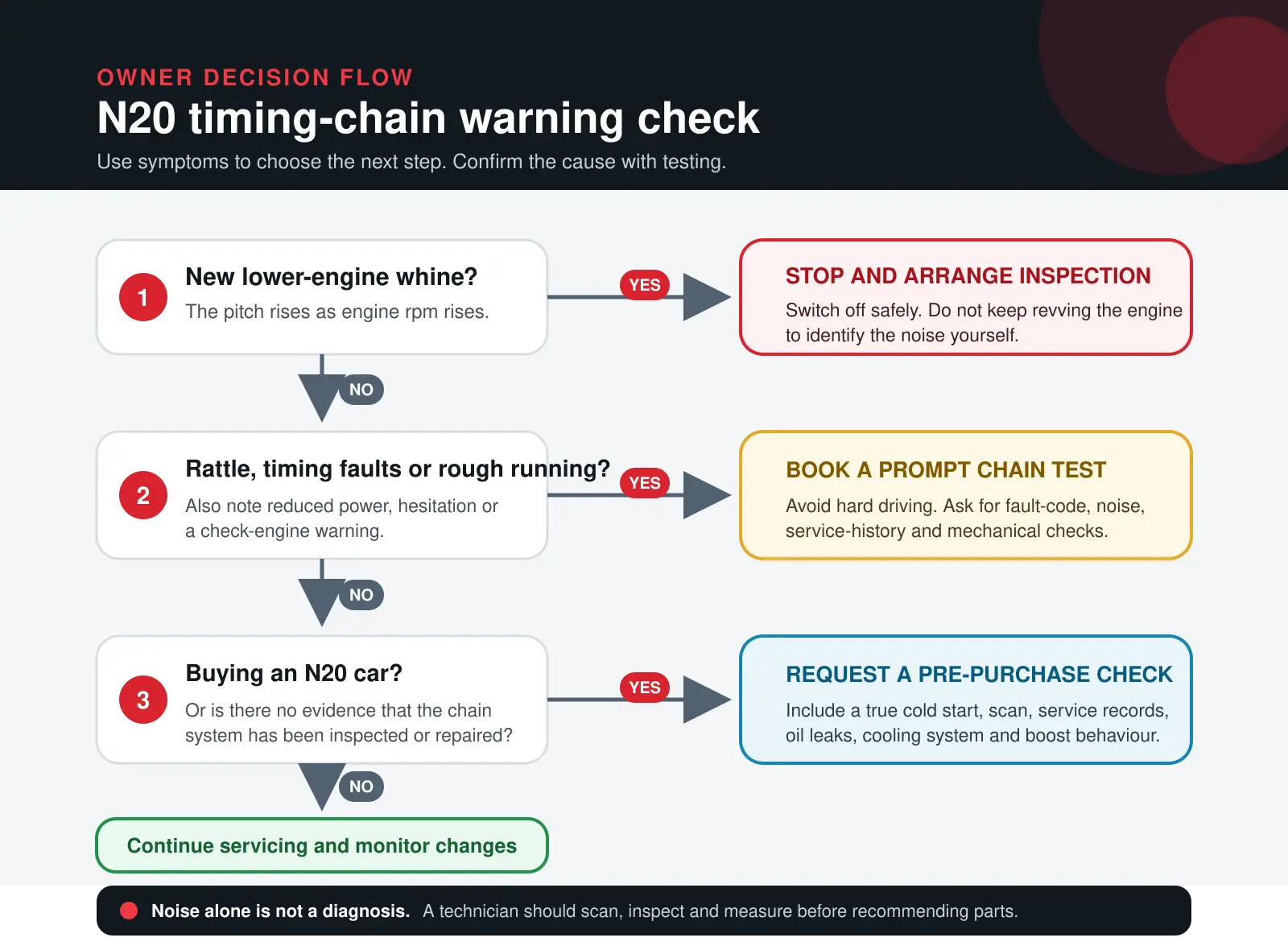
- A whine from the lower engine that rises with rpm. This is the specific situation described in BMW SIB 11 03 17. Switch off safely and arrange an inspection rather than repeatedly revving the engine to reproduce it.
- A metallic rattle at start-up or while running. Record when it happens, how long it lasts and whether the engine was fully cold. Accessory drives, VANOS components and other parts can also make noise, so the sound still needs to be located.
- Rough idle, hesitation or reduced power. These symptoms may occur when valve timing is no longer controlled correctly, but ignition, fueling, boost leaks and Valvetronic faults can feel similar.
- A check-engine or drivetrain warning. Camshaft timing, VANOS or crank-to-cam correlation faults are relevant evidence. A code describes what the control unit detected; it does not identify the failed part by itself.
- An oil-pressure warning or debris in the oil filter. Stop the engine and investigate. The condition of the oil-pump drive, pickup and lubrication system matters as much as the upper chain.
No single mileage proves that an N20 timing chain is safe or due for replacement. BMW’s bulletin uses vehicle eligibility and test results, not a universal replacement interval. Maintenance history, production date, operating condition and prior repairs all change the decision.
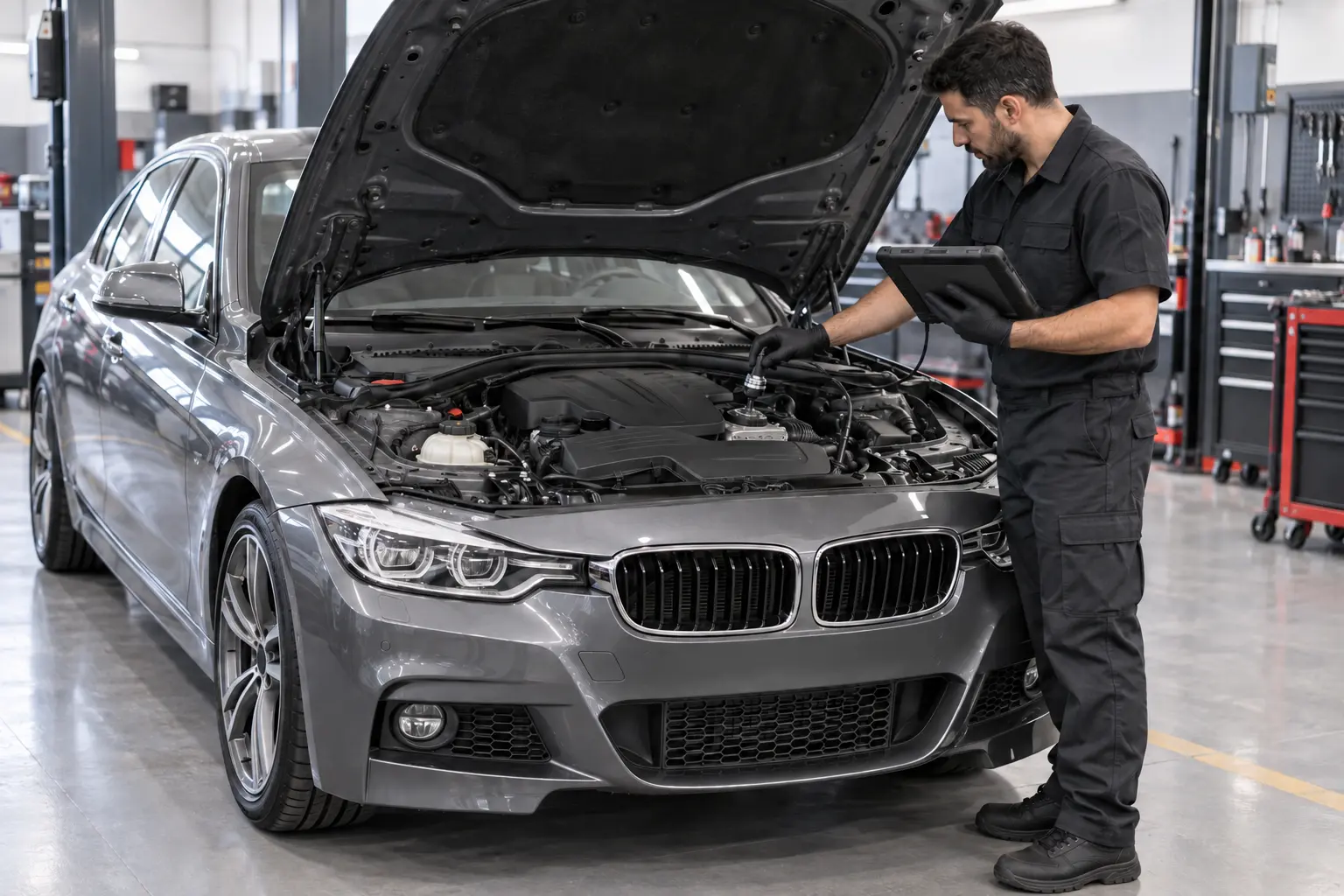
What a proper chain check includes
A useful N20 inspection combines history, sound, scan data and physical checks. Looking through the oil filler opening or pulling on a visible section of chain is not a complete test, and owners should not place tools inside the engine.
- Confirm the VIN, engine and production date. Check whether the engine is original, whether the timing system has been repaired and whether any market-specific campaigns remain open.
- Start the engine completely cold. A seller should not warm the car before a pre-purchase inspection. Listen for the first seconds of operation and again as the idle settles.
- Scan the DME before clearing anything. An Autel scan can preserve stored faults, pending faults, freeze-frame information, misfire counts and relevant camshaft or VANOS data. Recently cleared monitors deserve an explanation.
- Locate the noise. The technician should separate timing or oil-pump chain noise from injector ticking, belt-drive noise, a vacuum pump, turbo hardware and normal direct-injection operation.
- Inspect the guide area and lubrication evidence. Where access allows, a borescope can help identify visible guide damage. The oil filter and drained oil may provide evidence of plastic or metallic debris when concern is justified.
- Measure before recommending replacement. BMW’s service procedure uses a timing-chain test plan and a frequency-based oil-pump chain test. An independent workshop may use different compatible equipment, but the principle is the same: the repair decision should rest on repeatable findings.
When testing confirms excessive wear, the repair should be discussed as a system. BMW’s documented kit includes the timing chain, guide and tensioning parts, crankshaft sprocket and oil-pump chain drive components, along with the gaskets and fasteners required by the repair procedure. Engine oil and the oil filter are changed as part of the documented repair. If guide material is missing, the oil pan and pickup may need further inspection.
Replacement pricing varies with the model, drivetrain, parts choice and whether the engine already has secondary damage. For current service ranges and what the repair includes, see our BMW timing-chain replacement page.
Production date matters, but it is not a verdict
BMW SIB 11 03 17 lists certain US-market N20 and N26 vehicles produced through February 2015, including E84, E89, F10, F22, F23, F25, F26, F30, F31, F32, F33, F34 and F36 applications. That makes an early production date a useful screening clue.
It does not mean every car in that period has a failed chain, and it does not prove that every later car is risk-free. BMW explicitly described the US programme as a limited warranty extension, not a recall or instruction to replace parts immediately. For a UAE-market or imported car, confirm the engine and assess its actual condition. Do not copy a US warranty assumption onto a different market.
Other N20 problems to inspect
A timing-chain check should not consume the entire inspection. The N20’s direct injection, turbocharging, Valvetronic and Double-VANOS systems can produce overlapping symptoms. A car may have a healthy chain and still need work elsewhere.
Oil leaks around the cylinder head cover
Look for fresh oil around the cylinder head cover and gasket, oil tracking down the engine, a burning-oil smell and residue that returns after cleaning. BMW SIB 11 03 15 addressed cylinder-head-cover gasket leaks on N20 and N26 applications and warned that oil left around the filter housing after servicing can cause a misdiagnosis. Clean the area, identify the highest fresh point and confirm the source before ordering gaskets.
Oil filter housing condition
BMW also issued a service action for a limited group of N20 vehicles built from August 2011 to March 2012 because a black plastic oil filter housing could cause an internal or external oil or coolant leak. The action instructed dealers to identify the housing and replace the affected plastic unit with an aluminium version.
That production range is specific, so it should not be presented as a fault in every N20. For any used car, the practical check is still useful: identify the housing, inspect the housing and gasket area, look for oil or coolant traces and verify whether earlier campaign work is documented.
Cooling system and coolant-pump area
Check the electric coolant pump, thermostat, expansion tank, hose joints and cooling fan operation. Inspect for dried coolant residue and review any history of overheating or repeated coolant top-ups. An engine that has overheated needs more than a coolant refill; pressure testing and evidence of combustion-gas or oil contamination may be appropriate.
Imported cars also deserve a VIN-based campaign check. In 2024, BMW of North America announced a safety recall covering certain 2012 to 2018 vehicles for the coolant pump electrical plug connector. Applicability depends on the exact VIN and market. The recall should not be used to claim that every UAE N20 has the same condition.
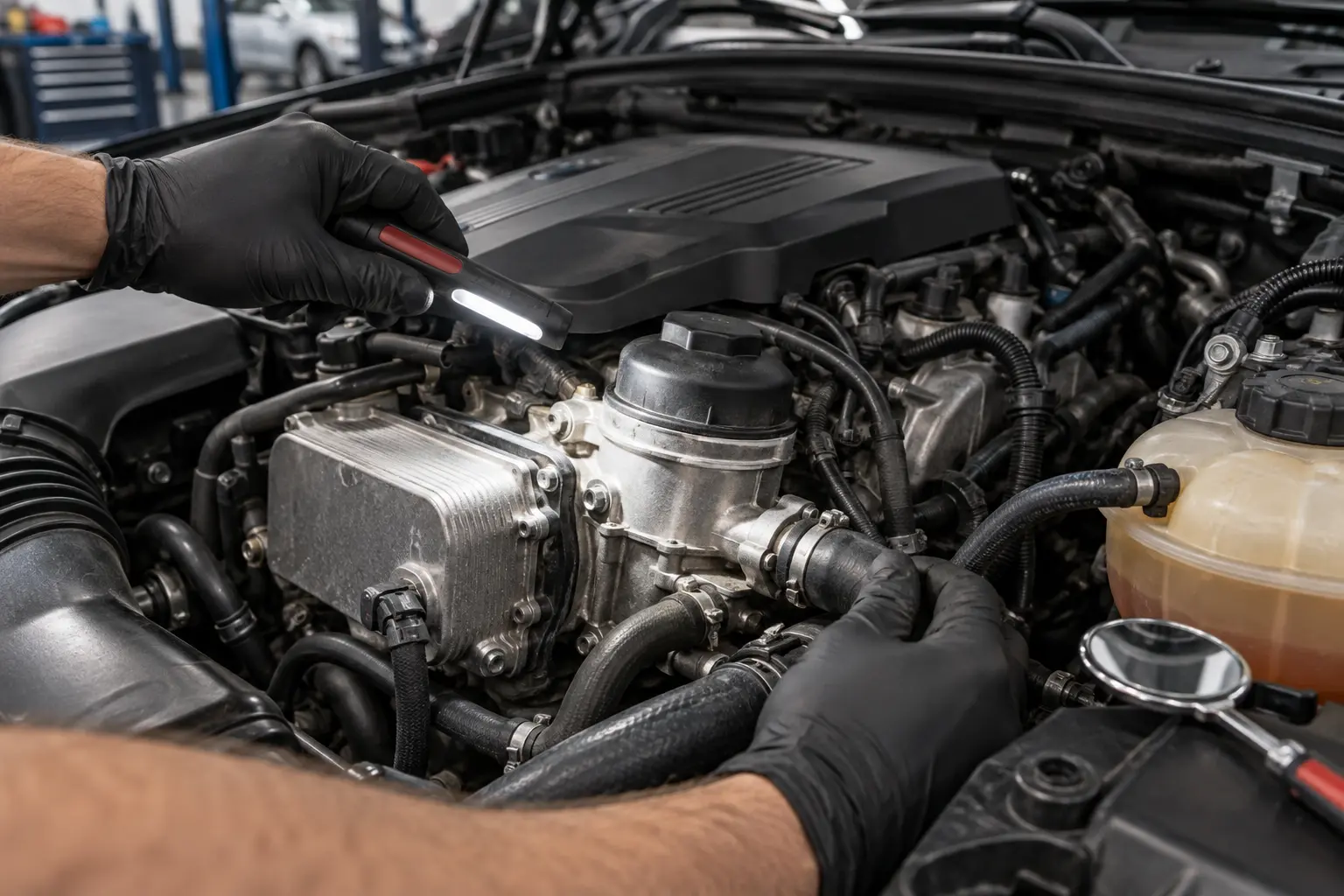
Boost control and air leaks
Inspect charge-air pipes, intercooler connections, vacuum lines and turbo control hardware. A split pipe or leaking joint can cause hesitation, reduced boost, mixture faults or a drivetrain warning without any chain problem. BMW previously documented juddering or surging under acceleration in hot ambient temperatures on limited early N20 applications where a turbo wastegate pressure-control component could bind. The symptom needs fault-code and boost-control testing rather than an automatic turbo replacement.
Ignition, injection and fuel pressure
Misfires can come from spark plugs, ignition coils, injectors, wiring, compression, air leaks or fuel pressure. Read cylinder-specific misfire data, fuel trims and rail-pressure behaviour before swapping parts. On certain N20 and N26 applications, BMW issued injector-specific guidance for a particular injector index. That is another reason to record part numbers and calibration details instead of treating every N20 injector as identical.
VANOS, Valvetronic and engine mounts
Rough idle, hesitation and vibration do not always point to the chain. VANOS control, the Valvetronic system, vacuum leaks, crankcase ventilation and worn engine mounts can change how the car feels. Diagnosis should establish whether the engine is actually running unevenly or whether normal engine movement is being transferred through a failed mount.
Review the service history properly
A folder of invoices is more useful than a seller saying the car was “always serviced.” Look for the correct VIN, dates and odometer readings. Check for consistent engine-oil and filter changes using oil that meets the specification for that vehicle, with no long unexplained gaps. Confirm whether oil leaks were repaired, whether the cooling system has overheated and whether the chain system was diagnosed or replaced.
If a timing-chain repair is listed, the invoice should identify the parts replaced. A useful record distinguishes the timing chain from the oil-pump drive, guide rails, tensioner, sprocket, gaskets, oil and filter. It should also explain whether guide debris or internal damage was found. A vague line such as “engine work” is not enough evidence.
For a used-car purchase, arrange a BMW pre-purchase inspection before paying a deposit that cannot be recovered. A proper check should include a cold start, full scan, leak inspection, cooling-system assessment, road test and lift inspection. The chain question is central, but it is not the only ownership risk.
When to walk away from a used N20
Pause the purchase when the engine is already warm on arrival, recent fault codes have been cleared without records, the seller will not permit an independent inspection or the oil-pressure warning has appeared. A pronounced mechanical whine, visible guide damage, debris in the oil system, low compression or cam-to-crank timing faults also need a repair estimate before the car is valued.
A previously repaired car can still be a reasonable purchase when the work is documented, the correct parts were installed and the engine passes its current checks. An untouched engine is not automatically better than one that has received a complete, well-recorded timing-system repair.
N20 timing-chain questions
Does every BMW N20 engine have a timing-chain problem?
No. BMW identified eligible N20 and N26 vehicles for a US limited warranty extension, but it did not instruct owners to replace every chain immediately. Production date, VIN, symptoms, history and test results should guide the decision.
Can mileage tell me when to replace an N20 timing chain?
There is no single mileage that proves replacement is required. A car with incomplete oil-service history may deserve closer inspection at lower mileage, while a well-maintained car still needs testing if it develops relevant noise, faults or debris.
Is a cold-start rattle proof that the chain is failing?
No. It is a reason to investigate, not a final diagnosis. The technician should locate the sound and compare it with fault data, chain condition, oil pressure and other possible noise sources.
Can an Autel scan confirm an N20 timing-chain failure?
A scan can reveal timing, VANOS, correlation and drivability evidence, but it may not prove the mechanical condition on its own. The result should be combined with a cold-start check, noise localisation and mechanical inspection or measurement.
Should the oil-pump drive chain be checked at the same time?
Yes. BMW’s service information addresses both the timing chain and oil-pump drive chain. The repair plan should state which system failed its checks and which related components are included.
What is the difference between the N20 and N26?
The N26 is a related emissions-focused version used mainly in North American SULEV applications. It shares the timing-chain concern covered by BMW’s US bulletin, but parts and emissions equipment must still be matched to the VIN.
Technical sources
- BMW Group PressClub N20 technical overview
- BMW SIB 11 03 17 for N20 and N26 timing-chain and oil-pump drive-chain diagnosis
- BMW SIB 11 03 15 on N20 and N26 cylinder-head-cover oil leaks
- BMW SIB 11 13 15 on the limited early N20 oil-filter-housing service action
If an N20-powered BMW has a new mechanical whine, timing-related faults, an oil-pressure warning or an uncertain pre-purchase history, stop guessing and have the engine checked. Bring the VIN, service records and any video of the cold-start noise. Those details make the first inspection more useful and help separate a chain problem from oil, cooling, boost or ignition faults.
Need help with your BMW?
Tell the garage what you have noticed, what you want checked and which BMW you drive. The team can explain the sensible next step before you book.