
Has your BMW lost its usual pull, shown a drivetrain warning and stored code 120408? BMW 120408 means boost control has been switched off, often as a consequence of another engine-control fault. It does not, on its own, prove that the turbocharger has failed. Read the accompanying faults to find out why the engine computer restricted boost.
Before agreeing to a turbo, actuator or sensor replacement, establish what triggered the shutdown. A pressure-control problem and a separate engine fault can both lead to 120408, but they need different repairs. Start with the full scan, the symptoms and the conditions in which the warning appeared.
What BMW 120408 means
BMW service information describes 120408 as charging-pressure control being deactivated, with pressure build-up blocked, or as boost shutdown following another problem. Here, charging pressure means turbocharger boost, not battery charging. The description records a control response; the word “blocked” does not establish a physical obstruction in a pipe.
The DME, short for Digital Motor Electronics, is BMW’s petrol-engine control unit. A consequential code records its response to a problem elsewhere. The repair needs to address the initiating fault, not just erase the record of reduced boost.
Is it safe to drive?
The code alone cannot tell you whether the journey is safe. Read the complete Check Control message and follow the handbook for your BMW. Stop safely and arrange recovery if the engine shakes heavily, the engine light flashes with rough running, there is smoke or a strong fuel smell, an oil-pressure or serious temperature warning appears, or power loss makes driving in traffic unsafe.
If the message permits continued driving and there are no severe symptoms, avoid hard acceleration and heavy load while arranging prompt diagnosis. Do not perform full-throttle tests or try to force the car out of reduced-power mode. Our explanation of BMW malfunction warnings covers the broader dashboard-message decisions.
Read the faults beside it
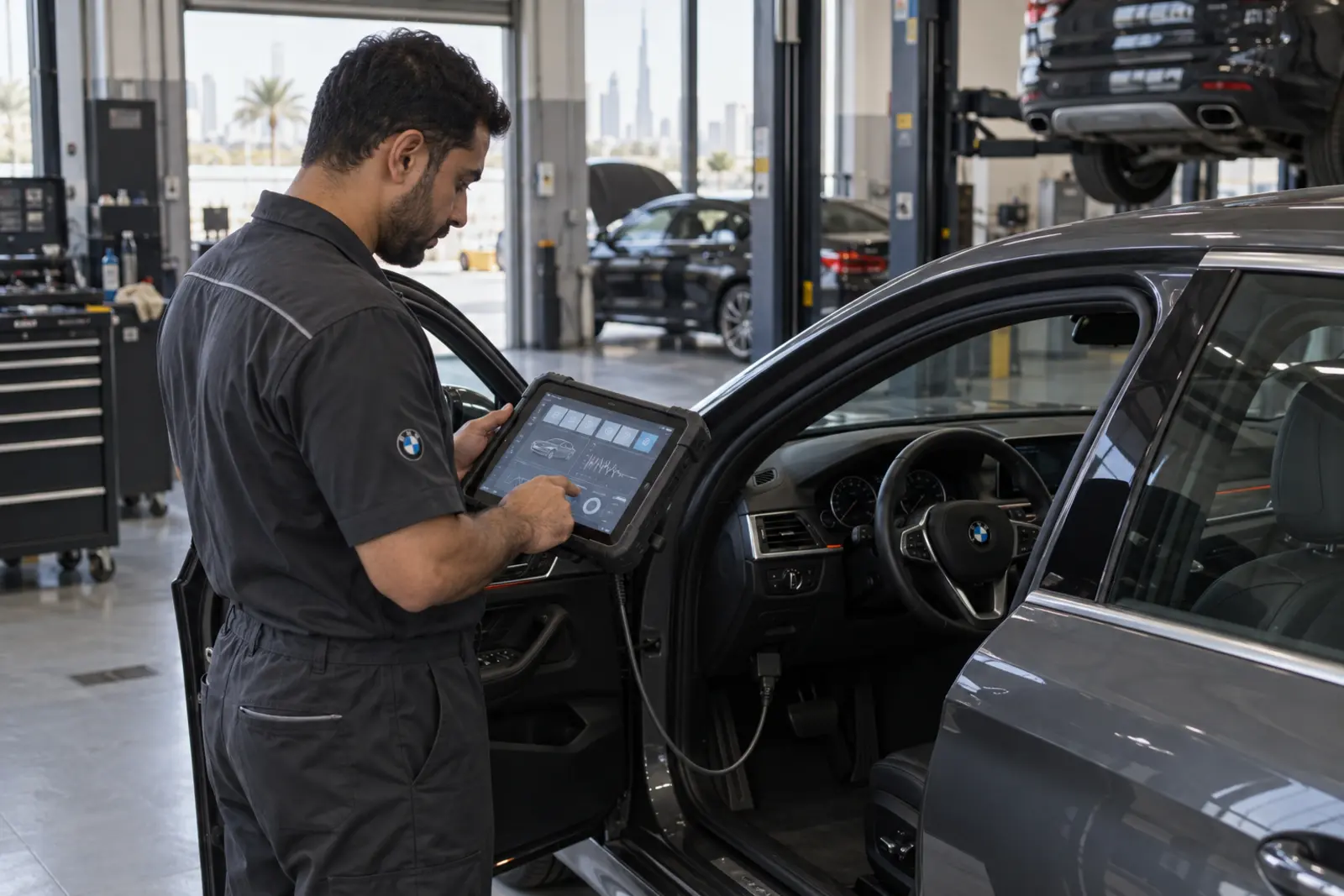
A scan that shows only “120408” leaves the main question unanswered: why was boost disabled? Save the complete report before clearing anything. Check the exact BMW fault descriptions, the module reporting them and whether each fault is currently present or stored from an earlier event.
Where available, keep the occurrence count, mileage and environmental or freeze-frame data. These describe the conditions recorded when a fault was detected. The first code on an app’s list did not necessarily happen first: a list sorted by code number is not an event timeline.
Low boost or excessive pressure?
120308 and 120408 are different codes. BMW SI B12 16 11 identifies 120308 as a pressure-too-low plausibility fault on the listed N55 applications. In contrast, 120408 records deactivation. Check every digit and the vehicle-specific description. [3]
Reduced power can also follow an excessive-pressure event. BMW documented 120208, a pressure-too-high fault, alongside 120408 on specified early S63T-powered M5 and M6 vehicles. Low boost after the intervention does not establish that the original problem was underboost; the software example below explains that distinction.
When another engine fault leads
Do not skip Valvetronic, fuel-pressure or engine-signal faults to concentrate only on the turbo. Follow the diagnostic priority for the actual combination. BMW’s N55 low-boost guidance calls for relevant accompanying engine faults to be diagnosed first.
A G12 7 Series bulletin gives a direct example: on the listed N63R application, a Valvetronic harness-connection problem could produce 120408 as a consequential fault. Valvetronic controls engine valve lift, not turbocharger boost. In that situation the wiring evidence matters more than the turbo-related wording of 120408. This is a model-specific example, not a harness-replacement instruction for every BMW. [2]
Checks before replacing the turbo
Once the fault pattern points towards boost control, the inspection should check the air path, control hardware and relevant signals. Low power can also originate outside the turbocharger, including the fuel system or an airflow restriction.
Charge pipes and intake leaks
Check the intake and charge-air pipes, joints, clamps and intercooler connections for leaks, damage or restrictions. If the warning started after recent work, inspect the connections disturbed during that repair first.
A workshop smoke or pressure test can help locate a leak. Follow the procedure and pressure limits for that BMW. If no leak is found, the next checks should follow the accompanying faults and live data rather than repeating the same test without a reason.
Wastegate control and actuator operation
Identify the actuator fitted before applying an online fix. A vacuum-operated system needs different checks from an electronic one. On the N55 applications covered by BMW’s older guidance, vacuum-hose condition and measured vacuum supply were important parts of the investigation.
For an electronic actuator, the checks can include supply voltage, connectors, wiring, commanded movement, position feedback and the mechanical linkage. An unsuccessful movement test needs to be interpreted alongside those findings. Leave rod adjustment and adaptation procedures to the workshop, using the correct vehicle information.
Pressure readings in context
Compare the pressure the control unit requests with the pressure the system reports, at the relevant engine speed and load. A single reading after boost has already been restricted cannot explain what triggered the restriction.
If a related fault concerns a pressure signal or actuator position, test the correct sensor, connector and circuit. The available live values, actuator tests and expected results depend on the fitted system. This is where a recorded result is more useful than a list of parts that sometimes cause reduced power.
Model and software differences matter
A repair that solved 120408 on another BMW is not automatically applicable to yours. Confirm the VIN, engine, production date and installed hardware. Include any intake, turbo or software modifications in the history.
Software becomes a plausible repair when the vehicle and findings match the applicable guidance. BMW SI B12 10 13, issued in May 2013, addressed S63T-powered F10 M5 and F12/F13 M6 vehicles produced through March 2013. It prescribed a software correction for the described excessive-pressure fault recorded above 6,000 rpm. That is a recorded fault condition, not an instruction for an owner to perform a high-rpm test. [1]
Use current vehicle-specific service information rather than treating that historical example as a universal update recommendation. Overseas bulletins do not establish recall, free-repair or warranty eligibility for a UAE-market or imported BMW.
Why clearing it is not a repair
A restart or code reset can restore the appearance of normal operation without identifying the original fault. Preserve the scan first. Even if acceleration improves, the condition that triggered the warning may return.
After the identified fault is repaired, verify boost operation and check whether the initiating fault recurs under safe, relevant conditions. Any necessary adaptation or software work should follow the procedure for the actual component. A cleared dashboard message alone is not a complete repair check.
If a turbo or actuator has already been replaced and 120408 returns, bring the original scan and invoice. Comparing the faults before and after the work can help identify a missed leak, connection problem or separate engine-control fault.
What to save before diagnosis
You do not need to identify the failed part yourself. These four details make the first assessment more useful:
- The complete scan. Save the codes, descriptions, status and available fault-environment data before erasing them.
- The warning and symptoms. Photograph the full message while parked and note reduced power, rough running, unusual noise or smoke.
- The operating condition. Note whether it happened from cold, after warming up, under acceleration or after a restart. Use observations from normal driving.
- The vehicle and recent work. Provide the model, year, VIN and any intake, turbo, wiring or software changes.
In Dubai, noting whether the warning appears after a hot journey is useful context, but heat alone is not a diagnosis. Leave loaded testing to the workshop and keep clear of hot or moving engine parts.
BMW 120408 questions
What if 120408 is the only code?
Request a complete BMW-capable scan and confirm its status and description. If the full report still shows only 120408, follow the vehicle-specific test plan and recorded symptoms. One entry on a basic scanner is not enough to select a turbocharger for replacement.
Is 120408 the same as underboost?
No. It records boost-control shutdown rather than the initiating pressure error. The separate 120308 description in BMW’s N55 guidance concerns pressure too low, while 120408 can also accompany an excessive-pressure event.
How much does fixing 120408 cost?
There is no single repair price for a consequential code. A connection repair, a leaking pipe, software work and a confirmed turbocharger fault involve different jobs. Establish the cause first, then request a quote separating diagnosis, parts, labour and VAT.
Will a remap or adaptation reset fix it?
Not as a general remedy. Raising boost or hiding a warning does not resolve a confirmed leak, wiring problem or mechanical defect. Resets and programming should be performed when the applicable diagnostic or repair procedure calls for them.
Technical references. [1] BMW SI B12 10 13, May 2013, S63T excessive pressure; [2] BMW SI B12 19 16, August 2016, N63R Valvetronic connections; [3] BMW SI B12 16 11, March 2013, N55 low-boost diagnosis. Each applies to its listed vehicles and conditions.
General diagnostic background: Garrett Motion, Turbocharger System Diagnostics Guide, Turbo Replacement / Turbo Diagnostics; HELLA Tech World, Electronic boost pressure control- turbocharger actuator testing, control-unit diagnostics. These support general test principles, not BMW-specific repair instructions.
Get the cause checked in Dubai
Still unsure why your BMW has stored 120408? Contact BMW Garage in Al Quoz, Dubai, with the complete scan, model and year, symptoms and recent repair history. Mention whether the warning appears under acceleration, returns after restarting or remained after parts were replaced.
Ask about BMW engine diagnosis and repair before committing to a turbocharger or actuator replacement. If severe symptoms or unsafe power loss are present, arrange recovery rather than driving to the workshop.