
BMW Garage · Al Quoz 4, Dubai
BMW i4 Repair and EV Service in Dubai
The i4 still needs brakes, suspension, tires, AC, 12-volt electrical and body care, while charging, thermal management, power electronics and the traction battery require EV-safe testing. We test the affected part of the energy path before recommending expensive components.
Initial electronic diagnosis guide AED 250–400 · High-voltage access or isolation testing quoted after intake
Estimates are guides for planning. The written quote confirms the exact work, parts, labor and VAT treatment for your car before approved work begins.
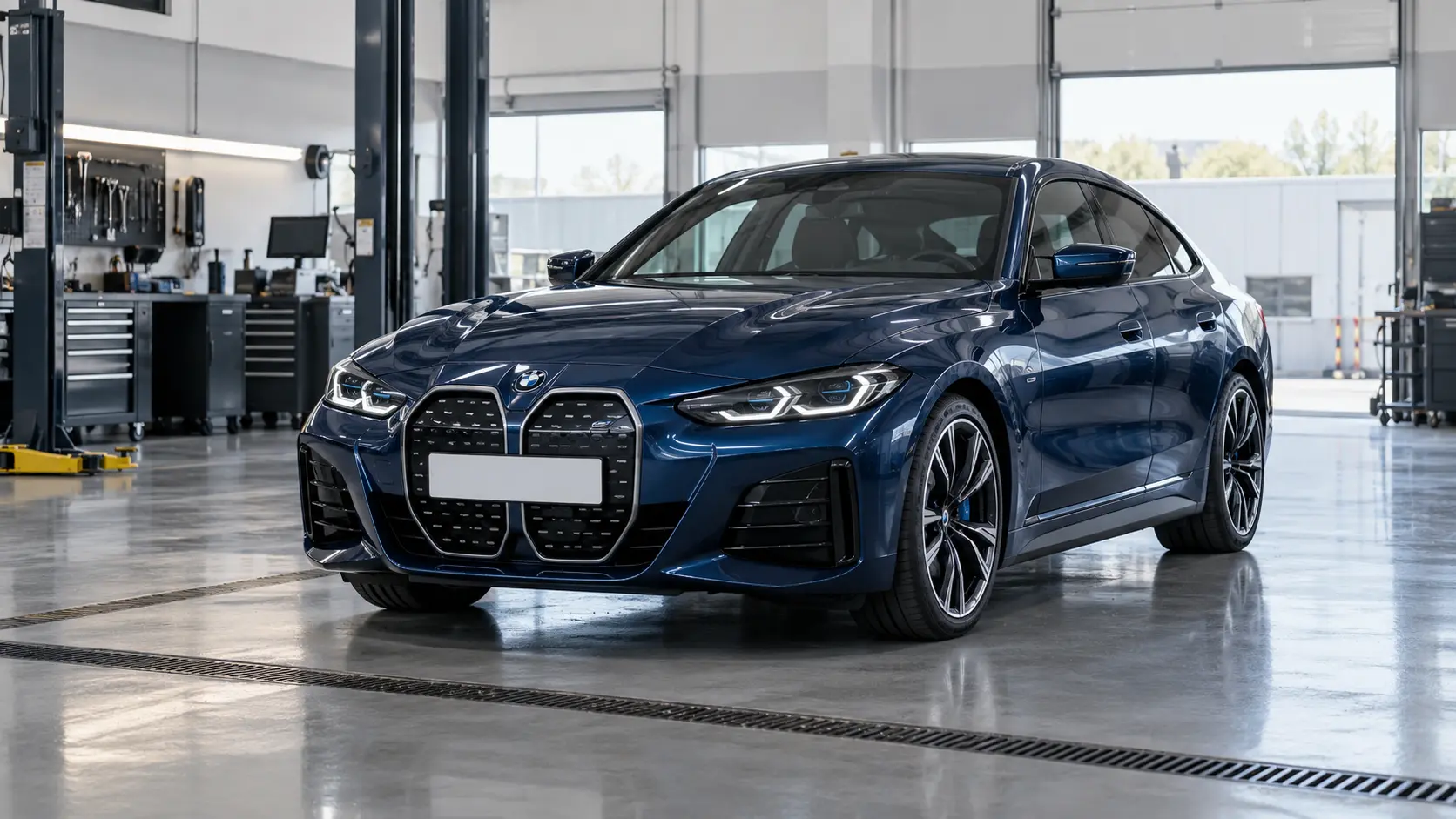
Follow the energy path
An i4 charging fault does not automatically mean a bad battery
A charging session depends on the supply, connector, vehicle communication, onboard high-voltage hardware, battery condition and thermal limits. Testing moves through that path in a controlled order.
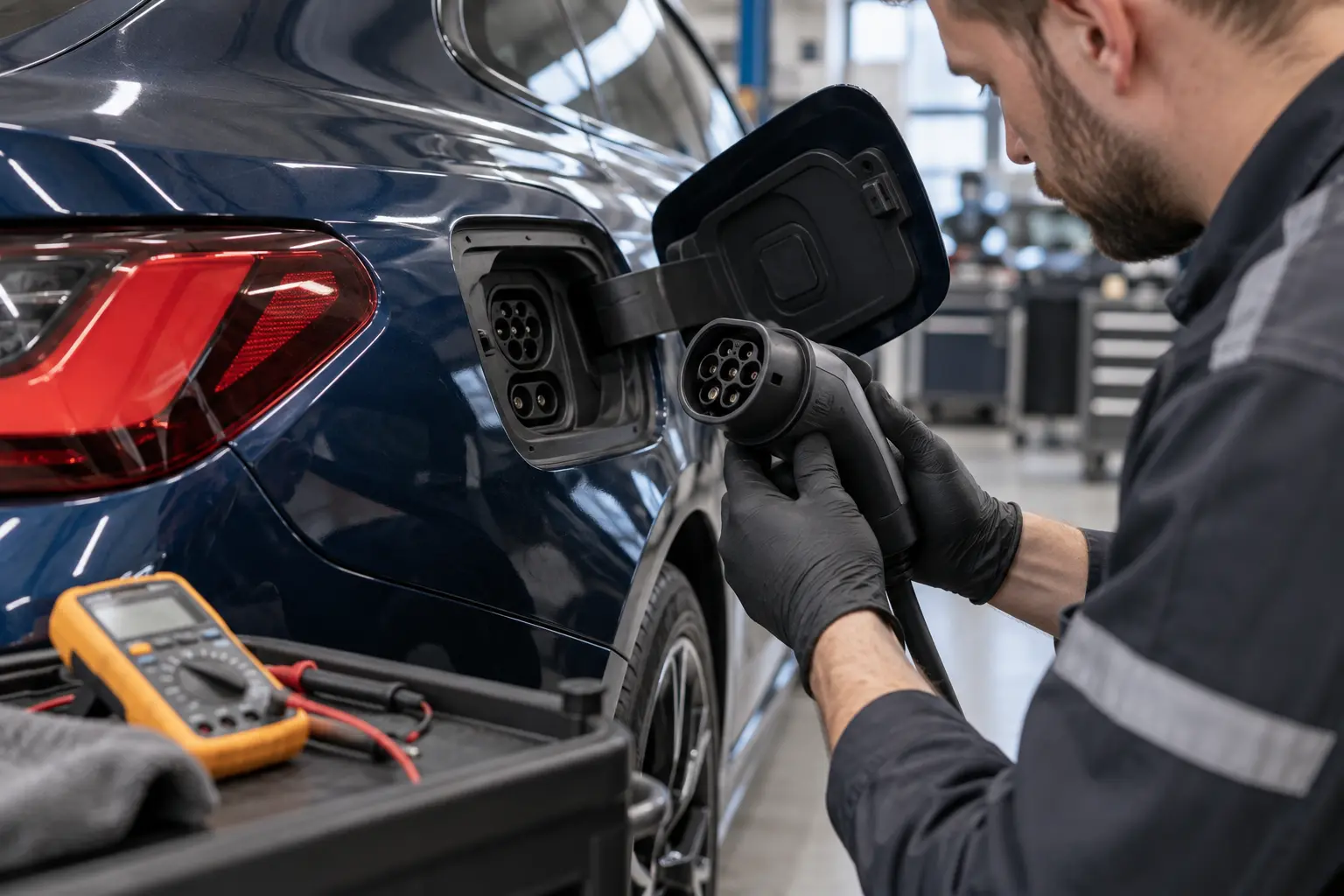
Supply
Charger output, cable and a known-working comparison.
Charge port
Pins, locking, temperature and communication.
Power electronics
AC conversion, DC path, control and cooling.
Battery
Authorization, isolation, temperature and usable energy.
Drive system
Rear or dual motors, inverter behavior and propulsion.
Start from what the car is doing
Know when to stop, limit use or book diagnosis
The exact display message, charging state and any collision, water, heat or smell information decide whether the car should be driven, moved only for loading, or recovered.
- Charging will not start
- Check whether the issue occurs at one charger or several, with AC or DC charging, and whether another vehicle charges on the same equipment. Photograph the message. The path can involve the cable, external supply, charge port, locking mechanism, communication, onboard charging hardware, thermal limits, 12-volt supply or high-voltage controls. We test from the boundary inward rather than blaming the traction battery.
- Charging is slower than expected
- Charge rate changes with battery state of charge, temperature, charger capability, shared-station limits and the car’s thermal or software state. A fast-charge session naturally tapers as the battery fills. We compare the complaint with available session information and scan data. One slow public charger visit does not establish an onboard fault.
- Range has dropped
- Displayed range responds to recent energy use, speed, temperature, climate demand, tires and route. A persistent or abrupt change can also warrant battery and thermal checks. We separate consumption from usable-energy concerns by reviewing history, tire condition, fault data and suitable battery information. We do not promise battery replacement from the range display alone.
- High-voltage or drivetrain warning
- A red or severe warning, loss of propulsion, burning smell, smoke, collision damage or visible underbody impact needs a stop-and-assess response. Do not touch orange cables or damaged high-voltage parts. Call with the exact message and location. Recovery may be safer than driving. Stored faults and isolation testing determine the workshop path.
- 12-volt symptoms and multiple warnings
- The i4’s control units, contactors and wake-up sequence depend on the 12-volt system. A weak battery or supply fault can produce access problems and several warnings even when the traction battery has charge. We test the 12-volt battery, DC-DC support and sleep behavior before treating every code as a separate high-voltage failure.
- Noise, vibration or brake concern
- Electric drive makes tire, bearing, brake and suspension noises easy to notice. Road-speed vibration can come from tires or wheels; a clunk can come from chassis parts; brake corrosion can appear when regenerative braking reduces friction-brake use. We inspect mechanical systems and do not label every unfamiliar sound a drive-unit failure.
Budget before approval
BMW i4 service and repair cost in Dubai
The first figure prices electronic investigation. High-voltage access, charging verification and battery work receive a separate written estimate because the safe test path depends on the warning and the vehicle condition.
| Work | Planning guide | What changes the price |
|---|---|---|
| Initial scan and electronic diagnosis | AED 250–400 | Warning, systems involved and depth of guided testing |
| High-voltage isolation or component access | Quoted after intake | Safety setup, branch localization, dismantling and test time |
| Charging-system repair | Written quote after diagnosis | Port, lock, wiring, onboard hardware, cooling or software |
| Brake, tire and suspension work | Written quote after inspection | i4 variant, M50 equipment, axle, wheel size and parts |
| Traction-battery work | Dedicated assessment and quote | Health evidence, isolation, physical damage, module or pack decision |
| Final invoice | Confirmed before approved work | Parts, labor, consumables, programming, calibration and VAT treatment |
These are planning guides, not a fixed menu for every configuration. Parts availability and VAT treatment must be confirmed in the written quote. No discount, warranty term, free service or collection promise applies unless the team confirms it for the booking.
Charging diagnosis
Test the vehicle side of the charging session safely
External supply, charge-port hardware, communication, onboard charging and thermal limits are separated before high-voltage components are priced.
- EV intake and safety classification
- The first decision is whether the car can be driven, moved in the workshop or needs isolation procedures. We record warnings, collision or underbody history, charging behavior and any smoke, heat or fluid. High-voltage work is separated from ordinary service. Orange-cable and battery-enclosure areas are approached with suitable safety controls, not treated like 12-volt wiring.
- Autel fault scanning and guided tests
- We scan relevant i4 systems and preserve the fault context before clearing anything. Freeze-frame information, live values and module communication help define the next test. Electrical measurements, visual inspection and safe procedures support diagnosis. A code naming a charging or battery function does not automatically justify a charge-port, control unit or pack replacement.
- Charging-system diagnosis
- AC and DC complaints are separated. We consider the external charger, cable, charge-port pins and lock, communication, onboard charging hardware, thermal limits and high-voltage authorization. Testing starts with non-invasive checks. The quote distinguishes a damaged connector, wiring repair, lock or flap concern, control issue and deeper power-electronics work.
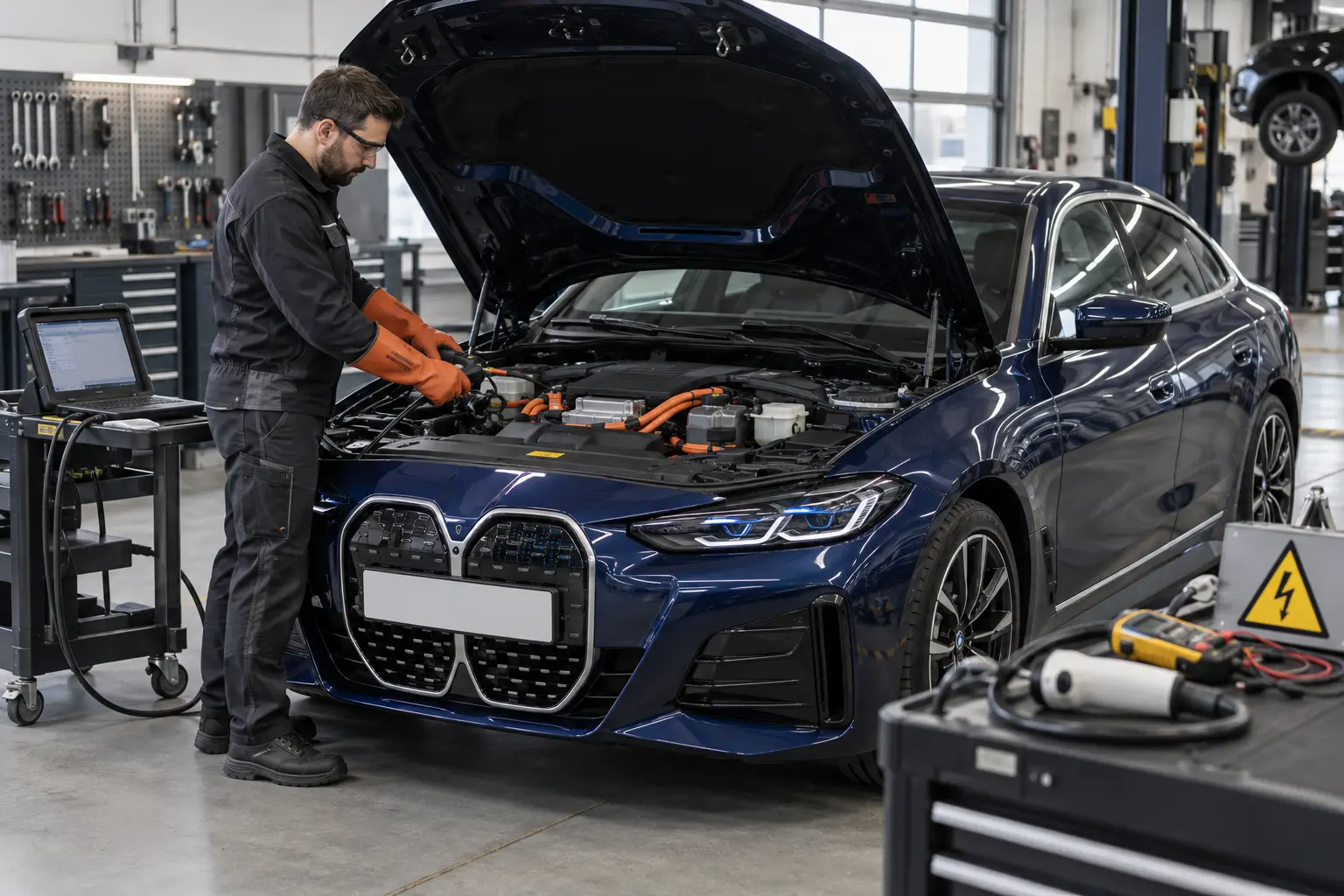
Battery and isolation
Localize the high-voltage branch before dismantling
Battery-health questions and isolation faults need different evidence. The first stage defines whether the concern is performance, physical condition or an unintended electrical path.
- Traction-battery assessment
- Battery work begins with warnings, available health information, usable-energy behavior, temperature data, isolation status and physical inspection. The protected enclosure and cooling connections are checked where appropriate. Module or pack work is not promised from a range estimate. Detailed battery intent belongs on the BMW i4 battery service page, which this general page supports instead of duplicating.
- High-voltage isolation testing
- An isolation fault means high-voltage energy may be finding an unintended path. Qualified testing follows safe shutdown and access procedures. Moisture, damaged cabling, charge components, drive units, HVAC equipment or the battery can be involved. The first diagnostic stage aims to localize the branch before dismantling. Owners should never probe orange cables or attempt a DIY reset.
Propulsion and temperature
Check drive units, thermal management and 12-volt support together
The i4 depends on both high-voltage energy and a healthy 12-volt operating system. Cooling or supply faults can affect charging, cabin comfort and propulsion without proving a battery-pack failure.
- Drive units and power electronics
- Rear-drive and dual-motor variants require different system mapping. Reduced propulsion, noise or communication faults can involve a drive unit, inverter or related cooling and wiring, but tires, bearings and 12-volt events may imitate parts of the complaint. We combine road behavior, scan evidence and safe electrical checks before pricing a major component.
- Thermal-management and AC repair
- The i4 controls battery, cabin and power-electronics temperatures through connected hardware and software. Weak cabin cooling, charging limits or temperature warnings can involve refrigerant, pumps, valves, sensors, heat exchangers, fans or control logic. Refrigerant work on an EV requires attention to system specification and electrical-safety boundaries. A gas top-up is not a complete diagnosis.
- 12-volt battery and parasitic draw
- The 12-volt battery supports access, computers, contactors and vehicle startup. We test its condition and charging support and investigate sleep or draw behavior when history suggests repeated discharge. Replacement specification and registration or initialization needs are confirmed. A charged traction battery cannot compensate indefinitely for a failing 12-volt system.
Road-going hardware
Service the brakes, chassis and tires as i4 systems
Regeneration changes how the friction brakes are used, while vehicle mass and torque make tire specification, wheel condition and alignment especially important.
- Brake inspection and service
- Regenerative braking reduces friction-brake use in some driving, which can allow surface corrosion or uneven contact. Pads, discs, calipers, fluid and electronic parking functions still need inspection. Brake work is measured and quoted by axle. A warning or vibration also brings wheel, hub, tire and suspension condition into the diagnosis.
- Suspension, steering and alignment
- The i4’s mass, wheel sizes and torque place clear demands on tires and chassis. We inspect arms, bushes, links, dampers, mounts, bearings, steering parts and underbody points. Alignment follows condition checks and relevant repairs. Adaptive equipment and M50 hardware must be identified so the part and setup match the car.
- Tires and wheel service
- Load rating, speed rating, axle size, acoustic design, run-flat construction and star-marked options affect tire selection. Rear-wheel-drive and xDrive variants may have staggered setups. We inspect tread depth and circumference, especially before a single-tire recommendation. Balancing, wheel damage and alignment are handled as distinct causes of vibration or wear.
Impact and verification
Inspect the underbody before clearing an impact concern
Shields, cooling paths, suspension and the protected battery enclosure are checked according to the event. Software, calibration and final charging or road checks follow the repair actually performed.
- Underbody and collision inspection
- A curb, road debris or collision can damage shields, coolant paths, suspension, body structure or high-voltage parts. Do not touch a visibly damaged enclosure or cable. Inspection documents impact areas and determines whether body, chassis, cooling or high-voltage testing is needed. Cosmetic appearance alone cannot confirm that the battery enclosure and isolation remain sound.
- Software, programming and calibrations
- Programming is considered when fault information, a replacement component or documented procedure requires it. Power supply must be stabilized and the correct vehicle state maintained. Camera, radar, steering or chassis work can require calibration depending on equipment. We do not sell a software update as a general cure for mechanical wear or physical damage.
- Road test and charging verification
- Post-repair checks follow the complaint. Charging work may need a controlled AC or DC session; chassis work may need a road test and alignment review; thermal work may need temperature and pressure observation. High-voltage warnings and leakage are rechecked as appropriate. A successful short test does not guarantee identical charge rate at every public charger.
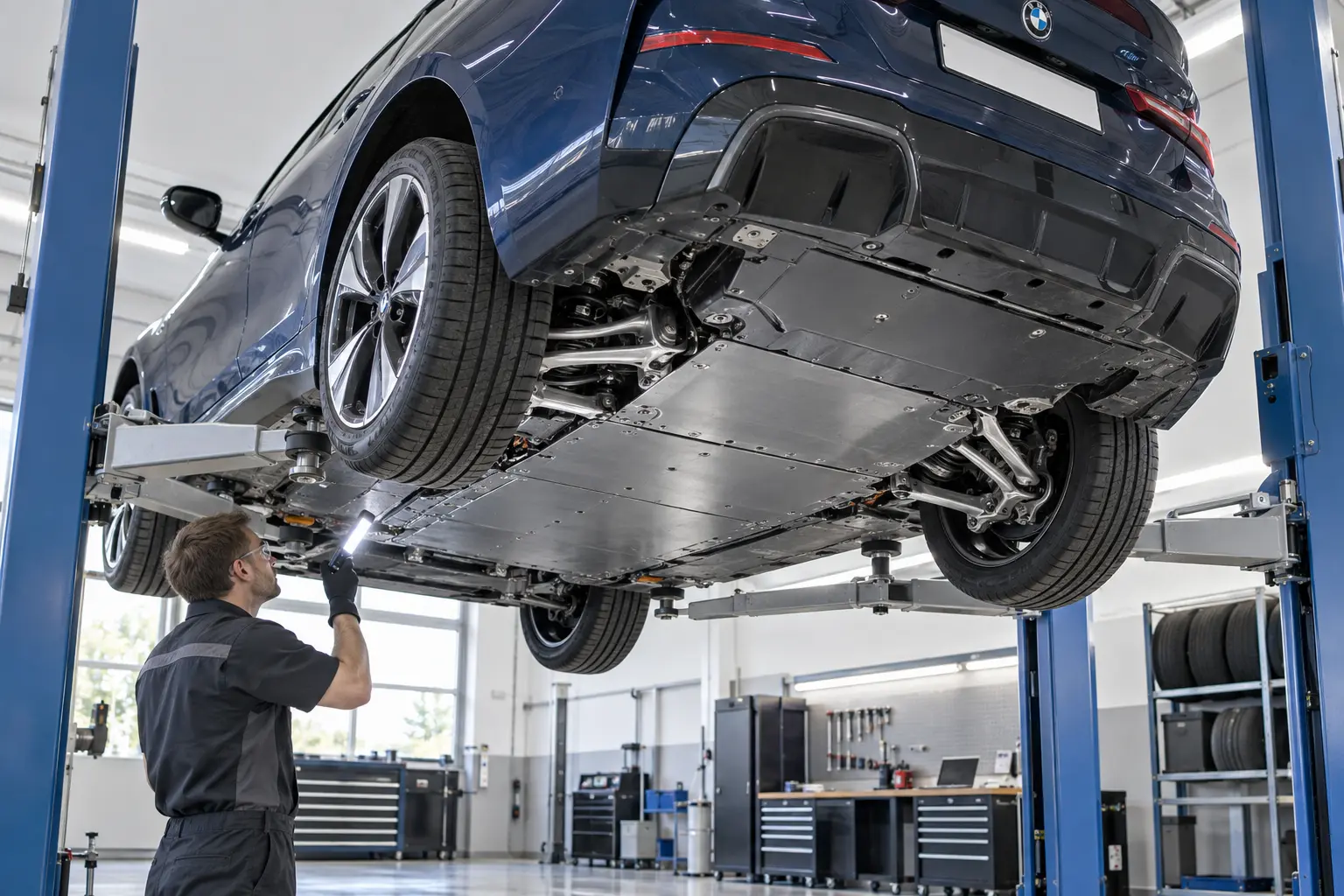
Useful EV evidence
Send information that shortens the diagnostic path
Charging history, impact details, tire fitment and the original warning help the workshop choose the right first test.
- Bring charging history, not only the current warning
- A useful charging complaint includes the charger type, stated power, start and finish state of charge, time, outside temperature and whether charging stopped or merely slowed. Screenshots from the charger or vehicle can help. We compare more than one known condition before deciding the car has a repeatable fault. Public-station limits and a normal high-state-of-charge taper should not be priced as failed vehicle hardware.
- Separate displayed range from battery health
- The range estimate responds to recent driving, climate use, speed, route, temperature and tires. Battery health concerns need a more controlled view of usable energy, faults and cell or thermal information available to the diagnostic process. A sudden persistent change deserves investigation, but one low estimate after fast motorway driving does not establish a damaged pack. We explain what the test can and cannot prove.
- Choose tires for load and the complete axle setup
- Immediate torque and vehicle mass can accelerate poor wear when pressure, alignment or tire specification is wrong. Send both axle sizes on staggered cars and mention whether the vehicle is rear-drive or xDrive. We measure tread across the width and compare circumference before a single-tire proposal. An EV marketing label never replaces the correct load, speed and dimensional fitment.
- Protect high-voltage areas after impact or flooding
- Do not crawl beneath the car, touch orange cables or open a damaged enclosure. After a curb strike, road-debris impact, collision or water exposure, report location, warning, smell, heat and visible leakage from a safe distance. The team can plan recovery and isolation checks. An undamaged bumper surface does not prove the underbody shields, cooling paths or electrical isolation escaped the event.
- Keep battery and general i4 work on the right page
- This model page owns the complete i4 service decision: charging, thermal management, drive units, brakes, suspension, tires, 12-volt supply, software and body concerns. The dedicated i4 battery page handles deeper battery-specific intent. Linking the two avoids pretending that every i4 complaint is a pack failure and gives owners a clear next page when testing points into the battery.
- Plan charging verification before collection
- A charging repair needs a repeatable check, but the correct check depends on the original complaint. An AC fault may require a known working AC supply and cable. A DC complaint may need an available compatible fast charger and enough battery capacity for the session to be meaningful. Temperature and state of charge are recorded because they influence power. Ask what verification is included and whether public charging fees or extra observation time appear separately.
From first call to handover
A repair plan you can question before approving
The purpose of diagnosis is to reduce guesswork and show what the next cost is meant to establish.
Send the exact warning
Share a dashboard photo, charge-station message, state of charge and whether the problem is AC, DC or both. Mention collision, underbody impact, water exposure, smoke, heat or unusual smell immediately. Do not handle orange cables or open high-voltage covers.
Classify driving risk
The team considers whether normal driving, reduced movement or recovery is appropriate. A mild convenience problem and a red high-voltage warning are not booked the same way. The owner’s manual remains the first reference for the displayed warning. Workshop advice is based on information available before inspection.
Map and test the affected branch
Autel scan data, 12-volt condition, visual checks, charging observations and safe high-voltage tests narrow the issue. Further access is authorized separately. The goal is to avoid replacing the most expensive component before a cable, port, coolant or supply problem has been excluded.
Approve and verify
The written quote names the supported repair and any programming, calibration, coolant, charging or road-test requirement. After work, relevant warnings and operating behavior are checked again. The handover records limits and follow-up instead of promising a universal range or charging speed.
BMW i4 repair questions
Clear answers about configurations, prices, safety and booking at BMW Garage in Al Quoz 4.
Do you replace BMW i4 batteries?
Battery work starts with diagnosis, not automatic full-pack replacement. We review faults, available health information, usable-energy behavior, isolation and physical condition. The repair or replacement choice depends on evidence and parts. See the dedicated BMW i4 battery service page for battery-specific help.
Why will my i4 not charge?
The cause can sit outside or inside the car. External supply, cable, charge-port pins and lock, communication, onboard charging hardware, thermal limits, 12-volt voltage and high-voltage authorization all matter. Tell us whether AC and DC charging both fail and whether another charger works. We test the path before pricing parts.
Is slower charging always a fault?
No. Charger capability, shared output, battery temperature and state of charge influence speed. Fast charging tapers as the battery fills. A repeatable large change across known working chargers may justify diagnosis. One session at an unfamiliar charger is not enough to condemn the car.
Can I drive with a high-voltage warning?
Follow the owner’s manual for the exact warning. Stop and arrange assistance for a red or severe warning, loss of propulsion, smoke, unusual heat, burning smell, collision damage or visible underbody damage. Do not touch orange cables or a damaged battery enclosure. Send a photo only after the car is safely parked.
Does the i4 need regular servicing without an engine?
Yes. Brake fluid, cabin filters, friction brakes, tires, steering, suspension, AC, cooling systems, wipers, 12-volt battery and body or software items still require attention according to condition and the vehicle’s schedule. It does not need engine-oil changes. Any page claiming routine i4 engine-oil service should not be treated as authoritative.
Why do the brakes rust on an EV?
Regenerative braking can reduce how often friction brakes work hard, so moisture and light surface corrosion may remain on discs. Driving pattern, environment and caliper condition also matter. We inspect contact, wear and movement. A safe braking or service recommendation depends on actual condition, not a blanket instruction to brake aggressively.
Can a weak 12-volt battery stop an i4 from starting?
Yes. The 12-volt system powers control units and the contactor sequence needed to make the high-voltage system ready. Multiple warnings or access problems can follow low voltage. We test the battery and its support before assuming the traction battery failed. Repeated discharge may need a draw or sleep investigation.
What i4 variants do you service?
The page covers G26 i4 variants including rear-drive eDrive models and dual-motor xDrive or M50 configurations, subject to market specification. Motor count, brakes, wheels, suspension and battery details can differ. We confirm VIN and fitted equipment before ordering parts or defining programming and calibration work.
Can you repair i4 AC and battery cooling?
We can diagnose cabin and thermal-management concerns. The systems interact, so weak cooling, charge limiting or a temperature warning can involve refrigerant, pumps, valves, sensors, fans, heat exchangers, wiring or control logic. EV refrigerant and high-voltage safety requirements are considered before work.
How much is i4 diagnosis?
The initial electronic diagnostic guide is AED 250–400. High-voltage isolation testing, component access, controlled charging tests or dismantling can require a separate quote after intake. The written estimate should state what question the test answers and whether parts, programming, coolant or calibration are included.
Can you inspect an i4 after an underbody impact?
Yes. Avoid driving if the battery enclosure, orange cabling or cooling components are visibly damaged, leaking, hot or showing a severe warning. Inspection can cover shields, enclosure condition, suspension, cooling paths, isolation status and body damage. Recovery may be the correct first step.
Where is the i4 workshop?
BMW Garage is in Al Quoz 4, Dubai. Call first with the warning and whether the car drives or charges. WhatsApp the year, variant, VIN if available, dashboard photo and charger details. The team can confirm a diagnostic slot and discuss safe transport when the car should not be driven.
Send the i4 warning and charging details
BMW Garage is in Al Quoz 4, Dubai. Call +971 56 464 6081 or send the year, variant, VIN if available and dashboard photo on WhatsApp. The team will confirm the next step, availability and any parts check.